Showing posts with label Judy Merrill Larsen. Show all posts

Monday, April 23, 2012

Six Authors Share What Inspired Their Novels

By Kim

Those of you who have been following What Women Write know that I recently finished The Oak Lovers, a novel based on the lives of my great-grandparents. Unless you’ve been stopping by since 2009, you may not know what compelled me to write their story.

My favorite childhood stories all involved a colorful character named Carl Ahrens. I adored the outrageous tales about young Carl running away from home to live with the Indians, befriending Calamity Jane, or making a catastrophic attempt to fly off the barn roof. He was a cowboy in pioneer Montana one night and the next he traveled the California coast by covered wagon.

Though I knew Carl was my ancestor, it wasn’t until I was much older that I associated the adventurer with the frail old man in the family photographs. How could a man who suffered from a crippling form of tuberculosis have had all those adventures? What about the woman beside him in the photos, the one who kept a comforting (or perhaps possessive) hand on his arm? He gazed at her instead of the camera, a look of naked adoration on his face. What was their story? I had to know it and, once I did, I had to tell it.

Many writers claim they had to write a particular book, but the reasons behind the need vary greatly. Today, authors Therese Walsh, Stephanie Cowell, Kathryn Magendie, Cathy Marie Buchanan, Judy Merrill Larsen and Erika Robuck join us and share their inspirations.

Therese Walsh – The Last Will of Moira Leahy 

There are so many layers to this question, and it might be answered in as many ways. At a base level, I think I was compelled to write because I sought professional gratification. I'd left a career as a researcher and writer for Rodale Press to become a stay-at-home mom. I had no regrets--not a single one--however I missed the world of more cerebral work. This persisted even after I began freelance writing from home, because that didn't satisfy my need to evolve as a writer. Once I hit on fiction--trying my hand at some children's picture book concepts before deciding to write a work for adults--the bug bit hard. My reasons for writing evolved then, became partly about recovering from the death of my father and other real-life events. But at root, I think I simply needed to feel like a relevant professional with something to say, and with the skill to say it.

Stephanie Cowell – Claude and Camille 

I was so passionately interested in writing Claude & Camille because most of my friends have been in the arts and, like the young Claude Monet, most of them have had a hard time managing their art and the needs of a normal life. Since the arts often bring little money, how do you pay the rent? And if the writer or singer or painter has a day job, she must fit her painting or writing in the evenings and weekends. She is constantly saying, “I can’t do any of these lovely social things because evenings and weekends are my time to…” It can be a real tension in a relationship; it can cause marriages to fail. If you are devoted to an art it takes an awful lot of time and money. So the story was dear to me because I lived it and many of my friends lived it. Claude & Camille is a bittersweet story because by the time Claude Monet had succeeded as an artist, he had lost Camille. I wanted to ask, “What is art worth? What was the cost of the beautiful water lily paintings?” It has no easy answer.

Kathryn Magendie - Sweetie 

While letting my first book (Tender Graces) simmer before chopping it to pieces (laughing), I wanted to see if I could write a draft of a novel in 30 days—not for nanowrimo, for at the time I’d not heard of it; I just wanted to see if I could discipline myself to the task. I started with a vague notion of a “special” girl who has scars on her body and lives in a small mountain. In the back of my mind was an article I’d read in Reader’s Digest magazine about a little girl who had a congenital insensitivity to pain, and how her mother had to watch over her so very carefully. Well, I wondered, what would happen if the mother couldn’t watch over the little girl? And what if this was during a time, and in a place, where this wasn’t a known condition? What if the girl and the town thought she was afflicted or cursed? I began writing: tippity-tap-tip-tap—wheee!

There I was la tee dah’ing away on a story-path and then one day during a walk in the forest on my mountain cove here in the Smoky Mountains, Sweetie “came to me.” She was so real in her faded cotton dress. She told me I had it all wrong—had her all wrong. I’ve never had this kind of experience with a character before. I may never have it again. And whenever I’d stray, she poked me until I had it “right.” Sweetie also affected the ending, which I angsted over so very much until I finally let it “go” and knew it was the only ending that could “be”—period.

Sweetie remains one of the most special of my books because of this feeling of something outside of me that can’t be explained. I had to write her, and I had to write her as “Sweetie” wanted me to. She, and I, could not rest until that was done. I have never seen her or felt her since finishing the book. I miss her but I’m glad she’s happy.

Cathy Marie Buchanan – The Day the Falls Stood Still 

When I set out to write The Day the Falls Stood Still, the story of William Red Hill, Niagara’s most famous riverman, was a natural place to find inspiration. Born and bred in Niagara Falls, Ontario, I grew up awash in the lore of Red Hill. I’d see the rusted-out hull of the old scow lodged in the upper rapids of the river and be reminded of him rescuing the men marooned there in 1918. I’d see the plaque commemorating the ice bridge tragedy of 1912 and know he’d risked his life to save a teenage boy named Ignatius Roth. I’d open the newspaper and read a story about his son, Wes, carrying on the Hill tradition and rescuing a stranded tourist. The hero of my story, I decided, would be loosely based on Red Hill. In creating a riverman with an extraordinary—perhaps even mystical—ability to predict the erratic behavior of the Niagara river and falls, I saw a chance to showcase the wonder I feel when I stand at the brink of the Niagara Falls.

Judy Merrill Larsen – All the Numbers

With All the Numbers, as well as manuscripts I've completed since, I've found that the story itself nags at me until I can't NOT write it. A scene will come to me--or several scenes, and I know that I have to dig deeper, I want to know what happens, I have to listen to these characters and help them get from point A to point Q or R or wherever they need to be. I suppose that all sounds very vague or all "whoo-wooey," but it's how it's worked for me.

Erika Robuck – Hemingway’s Girl (coming September 4, 2012)
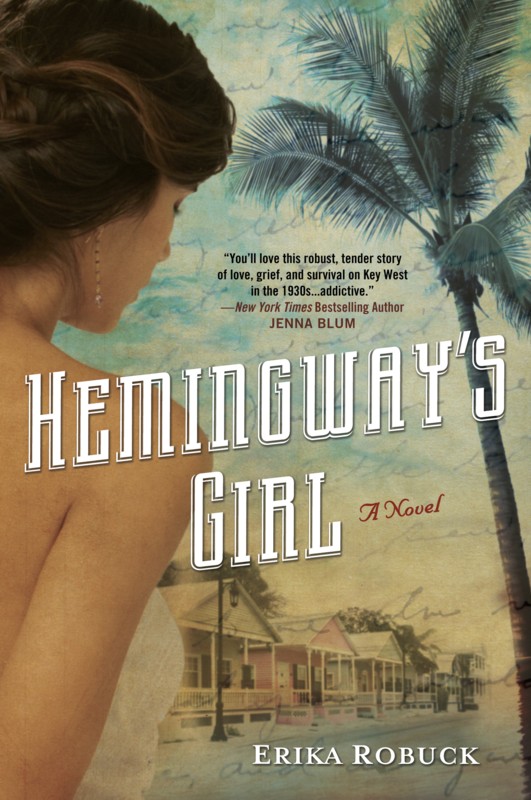
I hesitate mentioning this in mixed company, but what compelled me to write my novel, Hemingway's Girl, was a dream. I had visited the Hemingway House in Key West and felt an intense connection to my surroundings while I was there, but I was working on another novel. Not long after my visit, however, I had a dream where I was sitting with a young Hemingway in the Key West house, and he asked me to write about him because he’d become irrelevant. The next morning I shelved my other project and began Hemingway's Girl. The rest, as they say, is history.

Wednesday, May 25, 2011

A Conversation With Judy Merrill Larsen

By Kim

I first met Judy Merrill Larsen when I interviewed her about her association with the Fiction Writers Co-op, and now we both belong to the Facebook group for Writer Unboxed. Her novel, All the Numbers, sat unread on my Nook for over a month because I had been warned about how many boxes of tissues I would need. One night, after a particularly frustrating day with my youngest daughter (age five), a day when I knew I had blown many things out of proportion, I decided the one who needed the attitude adjustment was me. After the kiddos and my husband were in bed, I stockpiled tissues by the couch and dug in.

By page sixty-seven I forgot how argumentative and sassy my child was, and how anxious I had been to have her asleep and out of my hair until morning. I left a great white mountain of wadded up Kleenex on the coffee table and slipped into my daughter’s room. As I stroked her hair, she smiled in her sleep and murmured that she loved me. This opened the floodgates again, of course, and I spent half the night with her sleeping in my arms.

All the Numbers is not an easy read. It will take any mother, or anyone who has ever dreamed of being a mother, to a horrible place. That may not sound like a ringing endorsement, but it is. Save this book for a frustrating night like I had. Stop reading where you must and go hug your kids. Make sure to open the book again the next day and let Ellen’s nightmare slowly morph into a story of hope and forgiveness.

About All the Numbers (from the book jacket):

“How much do you love me?” Daniel asked his mother.

“I love you all the numbers.”

What begins as a sunny August afternoon on a bucolic lake turns into a tragedy when a Jet Ski swerves fatally close to shore. It’s a day Ellen Banks could never have prepared for, a day no mother should ever have to live through.

The moment her son James is killed, Ellen must face the unimaginable while trying to remain strong for her older son, Daniel, who witnessed the fateful accident and blames himself. Ellen’s shock and grief soon give way to defiance as lawyers and policemen who once vowed to support Ellen’s desire for justice succumb to political pressure and back away. Still, Ellen is determined to see the reckless young man pay for his crime and to heal her family’s deep wounds. But first heal herself.

An unforgettable journey of power and emotion, All the Numbers poignantly depicts a woman’s reckoning with her own vulnerability and finding in the wisdom of motherhood the redemptive grace to begin again.


About Judy (from the author’s website):

Judy Merrill Larsen was born in Whittier, California in 1960, and grew up in Northbrook, IL, Upper Saddle River, NJ, and Dunwoody, GA. She attended University of Tennessee (Knoxville) for two years before transferring to the University of Wisconsin-Madison where she graduated in 1982 with a degree in English and Secondary Education. She taught high school English in Madison for three years before staying home with her two sons. In 1991 she moved to Kirkwood, MO, outside of St. Louis where she received a Master’s Degree from Washington University and taught for twelve more years, first at McCluer North High School and then at Kirkwood High School.

She taught high school English in Wisconsin and Missouri for fifteen years. Her debut novel All the Numbers was published in 2006; she is currently at work on her second novel. She currently lives in Kirkwood, MO with her husband and their five children."

Interview:


WWW: Welcome to What Women Write, Judy! I have to say, I don’t cry often while reading books, but I absolutely sobbed during certain sections of yours. How did you survive writing that hospital scene?

JML: Oh, man, that hospital scene was a killer for me. But, I knew I had to get Ellen to the end. I couldn’t leave her there, so I made myself get through it so that she could ultimately get to the dock. But, I won’t lie. I cried when I was writing it and I cry anytime I read it.


WWW: You captured Ellen’s pain so believably that I quickly searched for interviews to find out if you had personally lost a child. Thankfully, you have not. Did you interview mothers who had or research the topic in other ways?

JML: You know, I think as moms, we always live with that fear of something happening to one of our kids. And we’ve almost all had those moments of utter terror—when they get lost or are sick or whatever. I pulled a lot from when my younger son was hit by a car when he was in first grade. The ambulance ride, the nurses and doctors rushing in. He was fine, thank God, but for a few moments I wasn’t at all sure he would be. So, I forced myself to explore the what-ifs. And go all the way to those depths. That was my research.


WWW: What is your opinion on organ donation? Jet skis?

JML: I’m a huge supporter of organ donation. I now have friends whose lives have been saved because someone was generous enough to donate during the worst moments of their lives. So I urge everyone to donate. But I also think that for me, in the moment, it wouldn’t bring me any solace. I’d do it, but I’d hate that I was in that position. Jet skis are another matter. They terrify me. I’m sure they are a blast, but I won’t ride or drive one. My sons? That’s another story. I know they’ve ridden on them, but never in my presence and never with my blessing.


WWW: I absolutely love the title. Can you tell us how you came up with that?

JML: Oh, thanks. I love it too and was so glad the publisher didn’t change it. It stems from my own life with my boys. When they were little, I said it to them in much the same way Ellen says it to James and Daniel. But, I didn’t know I was going to use it in the story until Ellen said it in the ER.


WWW: Do you think you could have done what Ellen did in the end?

JML: I hope I could have. I tried to be as honest as I could with how Ellen handled all of this—which is why I didn’t want her to be all noble. I wanted her to be angry and vindictive and sad. I wanted her to drink too much and start to slip away from her older son because that seemed honest to me. But, I also wanted her to ultimately look outward from her grief and find a way to move forward with her life if for no other reason than to honor James. I like to think that’s how I would be. But I don’t ever want to have to know for sure.


WWW: You were an English teacher for quite some time. Do you feel that teaching made you a better writer?

JML: I do think it did. I love teaching English (and before that being an English major!). Spending 15 years teaching students how to analyze literature and write clearly was invaluable. Being able to immerse myself in great literature day after day was wonderful.


WWW: I have a horrible time trying to balance my writing and family life with two kids. You have five! How did you do it?

JML: It is a challenge, isn’t it? And before you give me too much credit, when I wrote this I just had my two sons—we’re all now a Brady Bunch family (but without Alice, darn it!)—and now they’re all out of the house. I do think one of the biggest hurdles, though, is convincing anyone in my family that I’m working. They see me in my jammies, drinking coffee, with my laptop open and figure they can ask me something or I can whip them up a fried-egg sandwich or drive them somewhere. When I finally turned a little room on the 3rd floor into my office, that really helped. I could say I was “going to work” and shuffle on up.


WWW: What are your writing habits/quirks?

JML: No computer games when I’m in my office. Seriously. That, and good coffee (I even have a specific “writing” mug). I set word count goals for myself—usually I shoot for 1500 words per day. I never stop when I’m stuck. And, at the end of the day, I like to jot out a few notes for where I think my characters will take me the next day.


WWW: What are you working on now?

JML: Well, I’m waiting to hear from my agent about a MS that’s out on submission (and I’ve pretty much got everything crossed). I’ve got three ideas and I’m trying to decide which one to latch on to. So, that’s frustrating. I need to pick one and run with it, but I can’t seem to focus. Maybe I just need to pull one out of a hat or draw straws or something.


WWW: Any advice for aspiring writers?

JML: Don’t stop. Don’t give up. Keep revising. With ALL THE NUMBERS, it took 7 years from when I wrote the first word of the first draft to when it was in the stores. Over 300 agents rejected me. But it just takes one “yes.” Read. I firmly believe that reading other novels is part of my job (what a great perk, huh?). And keep writing.

WWW: Thank you for chatting with me today, Judy, and for your inspiring words. Over 300 agents – WOW! That really proves the power of persistence…

If you (our readers) have further questions or follow up comments for Judy, she has graciously offered to read and respond to any comments left for her on this post.
 

All the Numbers is available at bookstores everywhere, and also on the Kindle and Nook.

Friday, April 1, 2011

The Fiction Writers Co-op

By Kim

Late last year, New York Times bestselling author Cathy Marie Buchanan formed a Facebook group called the Fiction Writers Co-op, a band of fifty published authors who help promote each others' work and cheer each other on. I have been aware of the FWC since its inception since many of the authors involved are among my Facebook friends, but only recently have they been receiving some real press. As many of our readers are aspiring authors, I thought it was long past time to do a post on FWC. Membership in this particular group is currently capped, but one author pointed out that anyone can create a similar group using social networking sites. With the publishing world being what it is today, I have the feeling this is the first of many author co-ops.

For our readers who simply love books, please click here for an official list of books recommended by the FWC.

I apologize ahead of time for the length of this post, but there are five authors visiting us at What Women Write today, and I want to allow them all to have their say. Without further ado, please welcome Cathy Marie Buchanan, Stephanie Cowell, Therese Fowler, Melanie Benjamin and Judy Merrill Larsen.

I will start with Cathy because she is the founder of the FWC. After that, the remaining four authors will join in. I have only listed my questions in Stephanie’s contribution to save space. (This made it necessary to slightly tweak the beginning of some of Therese’s answers for clarity’s sake.)

Cathy Marie Buchanan (The Day the Falls Stood Still)

The idea of starting the co-op came to me when fellow Harper Collins Canada author Catherine McKenzie asked me if I had any great ideas for supporting the upcoming release of her latest novel, Arranged. I was already making daily book-related posts on my Facebook author page and would of course post about Catherine's release. With shrinking traditional media coverage of books, I expected there were plenty of authors on Facebook, with large followings of readers, who would be more than happy to do the same and, in turn, have their releases similarly supported. It was the premise with which I began approaching authors about joining the co-op. About half of those I approached joined. With the creativity, hard work and generosity of the authors involved, the co-op has morphed into a group where we not only promote each others' works but also share marketing know-how and a sense of community.

Stephanie Cowell (Claude and Camille, Marrying Mozart)

WWW: What drew you to join the Fiction Writers Co-op?

SC: I knew Cathy Buchanan and joined early -- before they filled up! I thought, how great to communicate with a group of wonderful fiction writers.

WWW: Have you seen/been a part of any other groups like this before?

SC: No, nothing like this. I have been on groups that helped you with history, but they weren't sharing experiences of working and surviving in the world of professional writing.

WWW: What have you gained from the experience?

SC: I have a great sense of community and know if I have any publishing questions, ten people can give me good advice.

WWW: Have you made any special contributions to the FWC?

SC: Nothing special...sharing agent advice, promoting each of the books on my website and sometimes buying them myself -- what better support is that?

WWW: What types of things do you see the FWC doing in the future?

SC: I guess forging new paths in PR and maybe finding critique partners but, most of all, I hope we can show other writers the real world of publishing and how to navigate it.

WWW: Anything else you wish to add?

SC: I think sometimes some of us are more involved than others at different times. These days I need to concentrate mostly on my book. And I always have to be aware that though most people may have a fan page, I don't wish to and that is enough. (I deleted mine.)

Therese Fowler (Exposure, Souvenir, Reunion)

When I got the invitation, which explained what the group was intended to be and do, I thought a co-op was an incredibly smart idea. A lot of authors-helping-authors goes on informally, but to organize and cooperate formally made so much sense—it would mean the efforts weren’t left to chance or whim.

I was also impressed by how varied the proposed group would be: seasoned pros and debs, award-winners, best sellers, all from an array of genres—Cathy Buchanan had clearly put a lot of thought into the group’s composition. She also asked for a commitment up front, which told me that anyone who accepted the invitation was likely to be a reliable participant.

I have never been in a group in this kind of specific and structured way. The closest comparison might be group blogs such as Jungle Red Writers, The Lipstick Chronicles, or The Girlfriends Book Club.

The FWC is a nascent group, so it’s too early to say whether any of our books’ sales have or will be increased because of the group’s efforts—though of course we hope so. And a lot of what we’re doing is untried, so there will be some hits and some misses along the way, I’m sure.

The sense of community, however, is tremendous and was unexpected. Every writer in the group brings his or her unique wisdom and insight to the mix. When one of us has a question or problem with any aspect of writing or the writing life, the others are quick to offer ideas, advice and support.

Plus, the community extends beyond the group’s parameters because of the close connections we each have to other writers. When I was first published, the idea of authors networking was almost unheard of. There were a lot of author and writer blogs, but Facebook was “for kids” then, and Twitter didn’t exist. I could count maybe three authors as friends.

Our raison d’etre is to assist one another in outreach to readers. So while I don’t know specifically how that will manifest over time, I do know we’ll keep looking for creative ways to connect with readers that are mutually beneficial.

There has been some misunderstanding in the writing community about what the FWC is, so I’d like to help clarify if I can.

We are a group of published authors who have banded together in order to help bring our books to more readers. As any author will tell you, the biggest challenge after getting a book published is getting readers to know it exists. The group size is limited to fifty, despite there being hundreds and hundreds of fantastic authors whose work all of us would support enthusiastically; this is because each member is committed to trumpeting the other members’ books. The whole endeavor takes more time than you might imagine, even with only fifty of us—and our real business, after all, is to write our next books.

So although the FWC is not a general writers support group, we are also not “elitist,” as a few writers have said. Size limit is a practical necessity. Everyone in the FWC was once a struggling writer who dreamed of being published—I personally am in my tenth year at this gig, with six of those years being pre-publication.

Now, that said, many of us do participate in support groups, we volunteer our time, we teach, and we encourage aspiring writers to get in touch with questions. Our public FWC page will sometimes feature articles, interviews, etc. that aspiring writers may find useful. All writers, published and unpublished alike, are working very, very hard to get to do the thing we love. There’s no place for bitterness in the writing world.

Melanie Benjamin (Alice I Have Been, Mrs. Tom Thumb - to be released in July 2011)

The amazing group of writers is what drew me to FWC. I have been invited to participate in other groups—and have done so in the past—but have decided to limit my involvement in these simply because I don't have enough time. The reason why I chose to stay with this group was because of the caliber of the authors, and the fact that it's all taking place on Facebook, which makes it easier for me as I already have a presence there. It doesn't require contributing to a blog, for instance—which is not something I really have the time to do right now.

What most of us have gained, so far, is the behind-the-scenes support; this is a place where we can complain/worry/brainstorm about the life of the published author in a safe, supportive environment. There has been a lot of solid advice given, freely. My husband helped out with sharing what he's learned regarding online advertising for my books, over the years. And then, I was the one who started the Group's Fan Page.

I hope we continue to support each other publicly and privately. The public sharing of each release is so helpful but truly, I think it's the group brainstorming, the sharing of advice that will be most worthwhile, in the long run.

Judy Merrill Larson (All the Numbers)

One day I received an invite from Cathy Buchanan to join the FWC—it was early—there were maybe only 10 to 15 of us at that point. I was thrilled. As you know, writing can be a very solitary endeavor and having other writers to celebrate/commiserate with makes such a huge difference. Plus, I loved the chance to shout out about others' books. I'd been doing that all along, of course, but this made it easier. I suggested a few of my writer buddies to Cathy, and when they joined it was great.

I've never been in a formal writing group (where we sit around and critique each others' work), but, through the wonders of technology/the Internet, I've been lucky enough to be part of some writing groups—I'm part of a group blog—The Girlfriends Book Club and that is similar in that we all support one another and share our triumphs and woes. Writers, at least the ones I've gotten lucky enough to know, are the most supportive folks around.

It's hard to directly relate an increase in sales to these groups, but I know it hasn't hurt. But the best thing has been the sense of camaraderie. We talk about the craft of writing, the frustrations and joys. The goofiness. It makes me feel so much less alone and makes it all so much more fun. I love walking into a bookstore and seeing one of my writing buddy's books on the table. I love saying, "My friend wrote this. You'll love it."

Our group continues to evolve—and we just started in December. I love our fan page—and I think we see it as a cool place for other writers to join in our discussion and really be a place for writers and readers to share. I know everyone is really excited about how we're reaching out to book clubs—in the five years since my book came out, I've met with over 100 book clubs, in person and on the phone, and it's one of my absolute favorite things about being published. Book clubs rock! (Just ask, by the way, and I'll happily meet with 100 more!)

I think, as a group, FWC has just scratched the surface of what we'll do and I just feel so lucky to have been here from the beginning.


Thank you so much Cathy, Stephanie, Therese, Melanie and Judy for being here today.
Related Posts Plugin for WordPress, Blogger...