Friday, April 30, 2010

What's your landscape muse?

by Kim

I imagine every creative person has a place of inspiration, a place where words flow effortlessly or the eye sees colors, shapes and textures with heightened sensitivity. Back in 2004, I found my landscape muse, a place I dream of, long for, and that forever changed me both as both a writer and a woman. Those who have followed us here at What Women Write for awhile already know I refer to Georgian Bay in Ontario. For those of you who have joined us more recently, click here to read the story about how a Texan fell in love with this rugged landscape of turquoise water, lopsided windblown trees, and rocky islands.

I’ve often told family and friends that if I could camp out in my friend’s cabin on Wahnekewening Beach, I could finish The Oak Lovers in six weeks. The cabin’s available anytime. With a husband and two small children here in Dallas, however, I don’t anticipate being able to move in anytime soon.
A couple of weeks ago, suffering from writer’s block and feeling restless, I decided I needed to find a closer source of inspiration, preferably one within fifteen minutes of my home.

I’ve driven by Restland Cemetery almost daily since moving to Texas back in 1997. When I’ve paid attention to it at all, I’ve noticed a perfectly manicured park. On this particular day I saw monarch oaks scattered over the grounds, inviting benches, and a complete lack of screaming children. Perfect.

An hour later I parked my car near the cemetery office and aimlessly wandered the grounds, waiting for a tree to call to me (so to speak). Since my novel features arguably one of the greatest forest painters the world’s ever known, I knew it could not be just any tree. Even if I had not spent the last four years hearing Carl Ahrens’ voice in my head, his blood runs strong in me. I’d recognize one of my great-grandfather’s wood spirits at a glance; I simply had to find something he’d have been moved to paint.

Within moments I saw an enormous oak with branches spread so wide I'm surprised it could hold them up. There's my tree, I thought. It couldn't beckon me more clearly. Upon reaching it, I peeked around the tree and saw my true destination – this pair. I smiled, seeing the womanly form enveloped by her larger male companion. Oak Lovers. In their shade, back to bark, I effortlessly composed an entire scene in a little over an hour.

I'm unsure if my burst of creative energy came from the tree itself or from the fact that I sat inches from two graves. Perhaps Edna Coursey (1894-1985) or Grace Newell (1899-1988) was a writer. Either way, I’m thankful, and plan to visit them again soon. Perhaps I’ll bring flowers.

So how about all of you? Tell us about your most surprising or unusual place of inspiration.

Wednesday, April 28, 2010

What a Coincidence!

by Elizabeth

So I'm trekking along with my WIP, and things are going pretty well. I didn't include its beginning in Karen's post the other day, because the current first line won't survive long. What's more likely is a scene now in the middle will open the novel, and the work of crafting the first sentence is yet in my future.

Although my blog reading recently has given me a touch of pause about one aspect of said scene. My main character is rushing off to an emergency and encounters a person from her past, a minor character who nonetheless matters later. What a coincidence! But maybe too much of one?

Over at the ever-useful edittorrent, Alicia recently blogged about coincidence in writing. Her thoughts sent me scooting around the web (ahem, research, not procrastination), where I found a useful essay in Rebecca Talley's blog. To sum it up, she urges writers to make it real if coincidence is to be used. Good advice.

Now I had to think hard about my own scene. My character runs into a man she once knew when his taxi runs into her. He's in town for business, and she, distracted and injured, doesn't recognize him at first, though he knows her immediately. The question is, will readers buy it?

Well, for what it's worth, I once ran into a fellow California college student in the McDonald's in the French Quarter. (Before you are appalled at my Crescent City dining choices, let me assure you I was merely confirming the weird rumor of biscuits and gravy on the menu. It was true.) Another time I saw a man I'd met in the jungles of Belize at an airport in Phoenix. And just yesterday a guy gave me a quote to trim my photinias, and I'm pretty sure he shared my row on a flight to Dallas in 1993. Coincidences all, and while you probably don't doubt me here, would you believe these things if you read them in a novel?

Jane Austen relied on coincidence; think of the revelation of Willoughby as the scoundrel of Colonel Brandon's life, and that circumstance eventually winning Brandon the woman they both love. Snape's dark motivation through all the Harry Potters is eventually revealed to be tied to the fact that he and a fellow young witch happened to play at the same park as children; what a coincidence! (At the same time, J.K. Rowling points out that sometimes things are too convenient, like when Hermione chides Hagrid's lack of suspicion when a hooded stranger happens to possess a dragon egg, something Hagrid covets.) In Julia Glass' wonderful novel I See You Everywhere, a chance meeting, the merest of coincidences, serves as a kind of glue. (Not a spoiler, don't worry.) Did I believe all of these? You bet I did. Because the authors did their jobs, and made these fictional lives as real as my own.

So that's the trick, I guess, and something my beta-readers will be warned to be on the lookout for when they get that first chapter: Is it real? Do you believe it? If they don't, I haven't done my job well enough and revision will follow. But to leave coincidence out of a book would be like erasing it from life. And what fun would that be?

Speaking of fun, oftentimes coincidences are just that. You are probably already familiar with the Presidents Lincoln and Kennedy stuff, and how the lyrics of "Amazing Grace" fit perfectly into the Gilligan's Island theme song music. (It's even more fun to sing the Gilligan verses with the hymn's tune.) But Love Boat and Star Trek? Who knew! And what about you? Any fun coincidences in your life, or a favorite from fiction?

Monday, April 26, 2010

There's Nothing You Can't Do

by Joan Mora

The other day I was in the car running errands. The radio was on, which for most people isn’t unusual, but I rarely listen to anything but books. It’s not that I don’t like music; I just like to take every opportunity to read more. That day, I had given up on two books on CD. I hadn’t fallen in love with the characters (oh, no, not that lame excuse again!) and the dialogue was cliché (or that!), so I ejected the discs and flipped the channels around, looking for a song I connected with. I was looking for something; I just didn’t know what.

As I scanned channels, I came upon Alicia Keys singing “Empire State of Mind.” For some reason, I got all choked up. I love New York, but I don’t think that was what struck me.

I’m from New York
Concrete jungle where dreams are made of
There’s nothing you can’t do
Now you’re in New York
These streets will make you feel brand new
Big lights will inspire you
Let’s hear it for New York


It might have been the melody pulling at my heart or the relevant lyrics, but mostly it was her stunning voice. The delivery. Just as in a novel, a good plot and interesting characters are essential. But if I don’t deliver the story in a compelling way, no one will want to finish reading and no one will remember it if they do.

Long after the song ended, it played in my head. Recalling Ms. Keys’ words, I couldn’t help but feel inspired. And I started to think about this dream of mine, to not only spend my life doing what I love best—writing fiction—but to also get paid for it.

As writers, we need to stay motivated. It’s a tough industry, full of rejection. Plenty of gifted writers give up their dreams all the time. We’ve heard it before—it takes more than talent. Rachelle Gardner recently blogged on perseverance. And Nancy Kress recently wrote that it takes practice. Ms. Keys believes: There’s nothing you can’t do.

Since that day in the car, I’ve had the song on my mind. I listened to a few versions on YouTube. Ms. Keys recorded one version with Jay Z, but I was looking for her solo version. I found it on “I Heart Radio.” At the beginning of the clip, she talks about her excitement at hearing one of her songs on the radio for the first time. I imagine it would be much the same as an author seeing her book on the shelves for the first time.

We are so lucky to have many new readers, thanks to our new Facebook page. We are What Women Write, and one thing I’ve noticed (in addition to a few of you being men!) is that the writers following us are in various stages of their careers. Some are new writers looking for advice on craft, others on querying, and still others have published one, two or many books. We have some industry folks as well. What do we have in common? Our desire to succeed in this crazy business.

Thanks for joining us here and remember: There’s nothing you can’t do!

For you pubbed authors, tell us, what did you do the first time you saw your book on the shelves?

Friday, April 23, 2010

On the Art of First Impressions


First Impression: noun - a lasting effect, opinion, or mental image of somebody or something.


I've been thinking about the first impression writers make with page one of their works. I don't know about you, but the first few sentences I write for any work-in-progress are written and re-written and re-written. This is all for good reason. Imagine the casual bookstore customer picking up a book at the store, reading the jacket flap, then the first page, only to put it back on the shelf because the style or immediacy of conflict or setting didn't pull them in. I confess - I am one of those casual readers. It may not be a fair assessment, but with so many books on my ever-expanding wish list, it's the one I use.

Now, I don't have any special advice to offer on the subject of first impressions other than this: you have to make a compelling one. One of my writing professors advised his students to do this by ensuring "your first sentence puts your own soul in jeopardy." I think what he meant by this was that the opening had to suggest something that touched a lightning rod within the writer; something that might even skate close to an idea or theme that troubles your sleep. When I was working on my novel JANEOLOGY, the questions that kept me up at night were: Aren't there signs when someone is about to have a mental break-down? And if so, wouldn't a person's spouse see the approaching storm? So for this work, my opening was: "I stared at my attorney as he began his defense that I did not share the blame in the murder of my son."

I think there's no better way to learn the art of the literary first impression than to read as many opening lines as possible and see how they hit you.

So, I'd like to invite everyone to contribute the first line of his/her work-in-progress in the comments section of this post. Don't be shy! Several of us at What Women Write will get the party started. Here are the first lines of our works-in-progress.

- - -

Martha Niles glanced at the stack of afternoon mail, still untouched on the table. The top envelope, identical to several others she had received over the past few months, bore the signature orb and cross logo of the Roycroft Shops in East Aurora. This one was addressed to Sarah Wainwright, her mother. – from THE OAK LOVERS by Kim Bullock

My mother once told me: Never date a man you wouldn’t marry. This followed on the heels of: You’re never fully dressed until you smile. Like most of her pearls of wisdom, I pretended to pay attention and then did whatever I pleased. - from WAITING TO KNOCK by Pamela Hammonds

Here is something you have to learn on your own: Not every person responds to words the same way. For example, my father shouted, got red in the face and told me not to call my mother crazy even though she tried to kill me. But I looked up crazy in the dictionary so I know I’m right.. - from TELL ME IN YOUR OWN WORDS by Karen Harrington

When we first met, a decade and a handful of change ago, I was hateful to Dorrie. She thought it was because of the color of her skin, but she was wrong. Up around eighty or so – maybe even seventy – a person forgets to use her filters. Or she’s beyond caring. - from ALL THE THINGS YOU ARE by Julie Kibler

I actually met Mac at the supermarket, so there goes any justification for disdain at my mother picking up men there. Still. This is hardly the same thing. For one, we weren’t lingering over a dish of chana masala, but in the regular, non-fragrant American supermarket, skimming blueberry muffin mixes, which are about as un-Indian as you can get if you think about it. - from KICK PUNCH BREATHE by Elizabeth Lynd

Gabriel Tucci felt the walls constrict, remembered each stroke of graphite on parchment, each thwack of setting maul to stone above the nave. No fat lemons, no olive trees, no grappa; when you seek a city of buildings and straight lines, do not be surprised when you are stabbed in the heart. - from THE ARCHITECT AT HIGHGATE by Joan Mora

--

Okay, now it's YOUR turn. Share YOUR first lines and/or tell me if there's a book with an opening that left a lasting first impression.

--


Three Writing Resources to Help Craft Your First Impressions

1. The 100 Best First Lines of Novels according to the American Book Review.
2. A cool selection and analysis of opening lines from famous novels featured on storyispromise.com
3. Susan Ishmael-Poulos' must-read piece on great beginnings.


Wednesday, April 21, 2010

Lazy River

I started the month of April with the intention of doing another writing marathon. I thought I'd set a goal of thirty thousand new words on my manuscript. I've done 40K two times -- 30K should have been a piece of cake, right?

So, here it is April 21, and I'm up to about 10K new words on my story. But I'm not crying. In fact, I'm pretty excited about those words and how they're flowing, even if they're flowing rather slowly. Sometimes, I think, a lazy river runs the deepest.

This story is kind of a different genre for me. It's still all about relationships and families, but I threw a historical element in there for the heck of it (well, and because it's the story that's been gnawing at me for about three years!). I never dreamed how much that would slow me down, though I'm not complaining. I've had many stops and starts, fine tuning the settings and time periods and voices.

I'm telling the story from the first-person voices of two women, one modern day and one in the past. I've given myself additional challenges beyond that by making these women extremely different from me – in age for one, in race and life circumstances for the other. Stories I've written in the past had point-of-view characters who were different from me, but they were all third-person, present day, so it was almost as though I were transcribing a movie I watched in my head. I didn't have to be quite as concerned with how these characters thought or worded things unless I was writing dialogue.

This time around, from first-person, it is both easier and more difficult to find my characters' voices. Each is quite distinct, and yet, when I get into the narrative, I still have to think carefully about how they'd view the scenes before them and how they'd tell them, being careful to keep them true.

I'm really enjoying telling this story from first person, though, and I believe it's both stretching me and making use of some writing abilities I don't usually get to show off in third person.

So, I think I'll be pleased to make it to twenty thousand new words by the end of the month, but you know what? I might only make it to 15K. Or I might make it to thirty. And I'll be happy I'm floating in this new river, wherever it takes me.

Photo credit:
Al HikesAZ's Flickr photostream, by creative commons license

Monday, April 19, 2010

Pearls

by Pamela

Many people say, "I always wanted to be a writer."

I’m not one of them.

I’ll admit to a life of floundering. My résumé reflects a pattern of two- to three-year stints. In my defense, most of the job changes were beyond my control, even though I do feel restless after working in one place for a few years. But when I review my job history, a common thread has been writing—ad copy, marketing materials, newspaper articles, magazine stories. Every job I’ve had up until now has paved this path to writing.

One life-constant has been reading. I learned to read at the age of four and pretty much read whatever I could get my hands on. (Not all of it appropriate, I’m afraid.) And from this voracious appetite for stories, I developed the desire to tell my own.

And so, one day, I sat at the computer and hammered out A FORGIVING SEASON, the story of Maggie and Wade. And while I’m still convinced there is still a story there, I know now the execution was not well done.

Since that first attempt, I’ve read many books on the art of writing fiction and attended a handful of workshops and writing conferences—a self-education process that has made what I write today much better than that first attempt.

So, I thought I’d share here, the top ten writing tips I’ve gleaned that have formed my writing career—which is still a work-in-progress.

ONE:
“In the beginning, when you’re first starting out, there are a million reasons not to write, to give up. That is why it is of extreme importance to make a commitment to finishing sections and stories, to driving through to the finish. …there is no point in practicing if you don’t finish.”
Anne Lamott in Bird by Bird: some instructions on writing and life
, "Writer's Block"


TWO:
“There are actually two beginnings to a novel: the first words the writer puts down to start the manuscript, and the first words the reader sees as she opens the completed book. These two…are not always the same…just start somewhere and sometime. You can always go back and redo the beginning.”
Bob Mayer in The Novel Writer’s Toolkit, “Tool 5: Your Story”


THREE:
“Dialogue is to the writer what the veto is to the president: It gives you great power and authority. If you overuse it, people…will resent you for it; if you use it wisely, they will applaud your control, your willpower.”
Noah Lukeman in The First Five Pages


FOUR:
If you feel a scene isn’t working, look at the point of view and consider changing it based on who has the most to lose/gain in the scene.
Sandy Blair, RWA Golden Heart winner, paraphrased from her talk at the DFW Writers’ Conference


FIVE:
“When you’re working on a story, remember the question that generated your story; let it be a chief organizing and focusing principle.”
Paula LaRocque in The Book on Writing, “Archetype, Character and Plot”


SIX:
When you finish a scene or chapter and are ready to stop for the day, DON’T. Continue on and start the next section. That way, when you open the file again, you’ll find it’s so much easier to pick up and go on rather than start from nothing.
Melanie Benjamin, author of Alice I Have Been, paraphrased from her talk at the Dallas Museum of Art


SEVEN:
“A responsibility of literature is to make people awake, present, alive. If the writer wanders, then the reader, too, will wander. There’s a fine line between precision and self-indulgence.”
Natalie Goldberg in Writing Down the Bones—freeing the writer within, “Don’t Marry the Fly”


EIGHT:
“…stopping a piece of work just because it’s hard, either emotionally or imaginatively, is a bad idea. Sometimes you have to go on when you don’t feel like it, and sometimes you’re doing good work when it feels like all you’re managing is to shovel shit from a sitting position.”
Stephen King in On Writing, section 29


NINE:
“At some point, you have to put the writing books aside and just write. Otherwise you’ll be the best writer no one ever reads.”
Joan Mora, my writing partner and dear friend


TEN:
“No matter how good you are, nobody is going to come knocking at your door. You have to take the risk of rejection and get that material out there.”
Elizabeth Berg in Escaping into the Openthe art of writing true


So, now it’s your turn. What’s the best writing advice you’ve ever received?

Friday, April 16, 2010

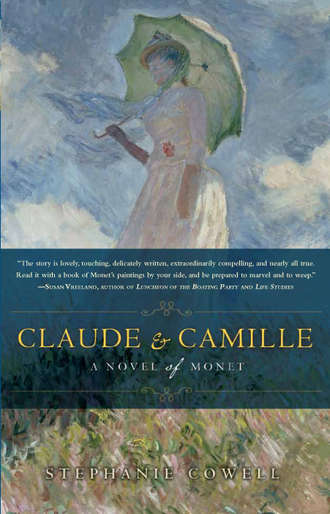
A Review of Stephanie Cowell's CLAUDE AND CAMILLE

By Kim

Synopsis (from the book jacket):

In the mid nineteenth century, a young man named Claude Monet decided that he would rather endure a difficult life painting landscapes than take over his father’s nautical supplies business in a French seaside town. Against his father’s will, and with nothing but a dream and an insatiable urge to create a new style of art that repudiates the Classical Realism of the time, he set off for Paris.

But once there, he was confronted with obstacles: an art world that refused to validate his style, extreme poverty, and a war that led him away from his home and friends. Except there were bright spots as well: his deep, enduring friendships with men named Renoir, Cezanne, Pissarro, Manet – a group who together would come to be known as the Impressionists, and who supported one another through the difficult years. But even more illuminating was his lifelong love, Camille Doncieux, a beautiful, upper-class Parisian girl who threw away her privileged life to be by the side of the defiant painter and embrace their lively Bohemian life.

His muse, his best friend, his passionate lover, and the mother to his two children, Camille stayed with Monet – and believed in his work – even as they lived in wretched rooms, were sometimes kicked out of those, and often suffered the indignities of destitution. She comforted him during his frequent emotional torments, even when he would leave her for long periods to go off on his own to paint in the countryside.

But Camille had her own demons – secrets that Monet could never penetrate, including one that, when eventually revealed, would pain him so deeply that he would never fully recover from its impact. Although Camille never once stopped loving the painter with her entire being, she was not immune to the loneliness that often came with being his partner.

A vividly rendered portrait of both the rise of Impressionism and of the artist at the center of the movement, CLAUDE AND CAMILLE, is above all, a love story of the highest romantic order.

About Stephanie Cowell (from the book jacket):

Stephanie is the author of Nicolas Cooke: Actor, Soldier, Physician, Priest; The Physician of London (American book Award, 1996); and The Players: A Novel of the Young Shakespeare. She is also the author of Marrying Mozart, which was translated into seven languages and has been optioned for a movie.

Review:

Normally I can breeze through a 330 page novel in an afternoon. CLAUDE AND CAMILLE took me five days. Like a Monet painting, I wanted to linger with it, to savor the composition, the colors, the emotions within. That Stephanie Cowell was raised by and around artists is evident from both the lush, visual imagery and the conversations between Monet and his contemporaries. She writes as a painter paints. A sensitive reader will, in turn, read in the manner of an art lover gazing upon a canvas.

Even if you don’t love art, you will be moved.

The bond between the two protagonists is so consuming I physically ached for them. I rejoiced in their triumphs, wept with them in their despair, and forgave them their trespasses. Camille may have been Monet’s muse, but there would be no water lily paintings today if it weren’t also for the love and devotion of Cezanne, Pissarro, Manet and Renoir. The power of friendship between these men can not be discounted.

Until recently, the only images I had seen of Claude Monet were photographs of an old man in his garden at Giverny. That man appears in the book, though a much younger Claude is at the forefront. On Stephanie Cowell’s website, you can see a stunning portrait of Monet as he would have appeared when he met Camille Doncieux. I confess to having a bit of a crush on him before even opening the book. After hearing his voice so vividly in my head for over 300 pages he’s flesh and blood to me; a loving, moody and virile man. If I were an upper-class Parisian girl with a stuffy fiancé, I’d be tempted to throw it all away for him, too.

I considered skimming a brief biography of Monet in between reading sessions, but refrained, and I urge anyone reading the book to do the same. You will only find facts about Monet there. Cowell offers something far richer; a glimpse into the artist’s soul.

I don’t advise reading the last thirty pages in public. Have tissues handy.

Today, I will visit the Dallas Museum of Art to see an exhibit called The Lens of Impressionism. I have already warned my companion that if she finds me lingering in front of certain Monet canvases she should forgive me the tears that will surely flow. Thanks to CLAUDE AND CAMILLE, part of me will always feel as though I stood beside Monet, watching him paint the Normandy shore.

CLAUDE AND CAMILLE is available at bookstores throughout the United States and Canada. You can also purchase it here at amazon.com.

Author and book cover images were taken from the author's website. Author photo by Russell Clay.

Related Posts Plugin for WordPress, Blogger...