Showing posts with label Joan Mora. Show all posts

Wednesday, April 29, 2015

Today We Say Farewell


Six years ago we started this blog as a way to share our writing journeys with others. Armed with humor, anguish and a lot of hope, we’ve posted numerous essays on craft and the publishing business, interviewed countless rock-star authors, and visited with editors and agents. Developing and thriving in this community has been so rewarding and we have each grown as writers and humans, developed life-long relationships amongst ourselves and with others we’ve met along the way.

We are not alone in finding the commitment of regular blogging as both a reward and hindrance to our real writing time. We are primarily novelists here – published and as-yet. And as with many time commitments, we had to weigh the joys of writing for this blog and (hopefully) helping others as we’ve been helped along the way. 

We’re sad to say goodbye to this page, but we are not saying goodbye to each other, our critiques, our community, definitely not our annual retreats.

We are ever grateful for your reading our words, for sharing your stories and comments, for traveling with us as we celebrated the joys of personal and professional milestones, comforted us in our rejections and tragedies.

Our posts will be there for you to peruse – a list of authors we’ve interviewed is on the right panel. And if you want to see what we’re up to, please visit us on our individual websites or pages. (links below)


Elizabeth Lynd


Farewell, all.

Tuesday, April 7, 2015

Three Boxes of Stories (originally posted July 5, 2010)

by Joan

This past weekend, I spent three days with family I haven't seen in years. We watched a slideshow of scanned photos, chatted about family trees and plucked our matriarch's memory for the family scoop. I haven't had time to reflect and write any of it down, so I found a previous post about my continued fascination with our ancestors.

Last week we spent a week in Maryland with my family. One of the highlights of the week was a whirlwind Sunday where we hosted a family brunch and then dinner for friends we don’t see often enough.

For the morning shift, I dug out three boxes of old family photographs. As we munched on bagels, quiche, and Costco granola (we swear it’s laced with crack), I sat next to one of my cousins, whose mind holds three generations of our family tree. With a pencil I jotted the names of great grandparents, aunts and uncles on the back of thick sepia photos, some so old the corners had disintegrated. Many remained unmarked as we debated to which side of the family the stern-faced, bustled ladies belonged.


Maybe one of the men is the artist of the Falmouth sailboat watercolor hanging above my desk and between the pages of The Cemetery Garden. Maybe the guy with the beard is Leo Tolstoy or Fyodor Dostoevsky. (Actually, he’s my paternal great-grandfather Zachary Levinson!)


In some faces we saw the shape of my face and eyes. In others we saw three generations of full lips and wavy hair. We’re fairly sure a few pictures were shot in Russia, before our relatives journeyed to Ellis Island. Others were taken in Brooklyn studios. Still others captured their daily life: three familiar faces posing proprietarily in front of a grocery/delicatessen, others in a confectionery, a young married couple standing tenuously side-by-side, my father (as a child) demurely atop a horse.

How will we ever identify those faces shamefully abandoned in the past, like elementary school friends who once pricked fingers and blended blood? Will our great-grandchildren forget us in the same way?

It got me thinking about the layers of our lives, how our ancestors’ actions and decisions affected not only our looks, but where and who we are now. Had they stayed in Russia, they might have lived in an isolated frozen community or been arrested and sent to Siberia. Maybe I wouldn’t be here now. Maybe I’d work in a government job and walk to work in knee-high boots and a parka. I wish my ancestors had written some of it down, like Kim’s great-grandmother. I have bags of WWII letters from my father, but nothing from the previous generation.

Is that why we write? So years from now, a descendant will find our words and understand us a little more clearly? When we write, we capture a mood or a setting in much the same way a photograph does. With just the right shading and lightening, cropping the boring parts. Posing our characters on a backdrop of plot.

Seeing these pictures also got my creative mind lassoing ideas for a future novel. Like Julie, I need to finish my WIP first, but I’m already excited about where these pictures will lead me. I’ve got about 500 more treasures to scan and, with that, a lifetime of stories to tell.

What about you? Have you found crumbling family photos? Do you know who they are?

Monday, March 23, 2015

On Joan Didion

by Joan

Several years ago I read Joan Didion’s Year of Magical Thinking, her raw and honest memoir covering the death of her husband and writing confidant, John Gregory Dunne, and the serious illness of their daughter, Quintana Roo (who recovered but later died).  

I always meant to read Didion’s earlier novels and essays, but never quite got around to it. Then about a month ago, I came across a fascinating 1978 Paris Review interview with Linda Kuehl, The Art of Fiction

When asked to clarify what she meant by: “Writing is a hostile act,” Didion replied, “It’s hostile in that you're trying to make somebody see something the way you see it, trying to impose your idea, your picture. It's hostile to try to wrench around someone else's mind that way. Quite often you want to tell somebody your dream, your nightmare. Well, nobody wants to hear about someone else's dream, good or bad; nobody wants to walk around with it. The writer is always tricking the reader into listening to the dream.”

In the interview, Didion said she began typing out Hemingway’s stories to learn how his sentences worked. “I mean they’re perfect sentences. Very direct sentences, smooth rivers, clear water over granite, no sinkholes.” Didion also noted Henry James as an influence. “He wrote perfect sentences, too, but very indirect, very complicated. Sentences with sinkholes. You could drown in them.”

After reading this article I decided I must search out more of her work. I started with Slouching Toward Bethlehem, a collection of essays published in the 60s. The audible version was performed by Diane Keaton, a perfect blend of narrator and author. Occasionally when listening to an audio book, I find myself rewinding to catch a sentence or scene I’ve missed. But while listening to these essays, I pushed rewind more often, not because my mind had wandered as sometimes happens, but because I wanted to hear the brilliance again.
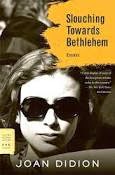


Aside from the John Wayne article in which he’s very much alive, and perhaps the title story covering the Haight-Ashbury druggie scene, the essays were surprisingly relevant and immediate to now. Whether California and its dichotomous personality and landscape, or New York in the author’s twenties, the essays are individual yet universal, abundant with literary inspiration. In “On Keeping a Notebook” Didion shares her thoughts on why a notebook is not a journal. She jots down snippets of conversations, places and times of random incidents, not as self-reflection, but as a chance to document how we create our own memories.

One cannot read Didion without wanting to capture some of her more profound statements, to quote and revisit.

“The impulse to write things down is a peculiarly compulsive one, inexplicable to those who do not share it, useful only accidentally, only secondarily, in the way that any compulsion tries to justify itself. I suppose that it begins or does not begin in the cradle.” 

“I think we are well advised to keep on nodding terms with the people we used to be, whether we find them attractive company or not. Otherwise they turn up unannounced and surprise us, come hammering on the mind's door at 4 a.m. of a bad night and demand to know who deserted them, who betrayed them, who is going to make amends. We forget all too soon the things we thought we could never forget. We forget the loves and the betrayals alike, forget what we whispered and what we screamed, forget who we were. I have already lost touch with a couple of people I used to be…”

I particularly liked her essay, “On Self-respect.” It seems an appropriate message for writers who live so close to rejection, but also for recent graduates who are struggling with what to make of themselves and where they will land in this world.

“People with self-respect exhibit a certain toughness, a kind of moral nerve; they display what was once called ‘character,’ a quality which, although approved in the abstract, sometimes loses ground to the other, more instantly negotiable virtues.... character—the willingness to accept responsibility for one's own life—is the source from which self-respect springs.” 

“To have that sense of one's intrinsic worth which constitutes self-respect is potentially to have everything: the ability to discriminate, to love and to remain indifferent. To lack it is to be locked within oneself, paradoxically incapable of either love or indifference.” 

It turns out, Didion’s style has the flair of both Hemingway and James: clear and direct, a smooth river with an occasional sinkhole to drown in. For more on Didion, listen to fascinating podcasts of her NYPL interview or talk with David L. Ulin as part of Aloud, at the Los Angeles Public Library.


Monday, February 23, 2015

Weather as a character

by Joan

As I write this, ice taps the windows and wind batters the chimney cap. I’ve just come in from helping my husband raise the exterior shades on the two-story window and my fingers are still numb. A snowflake icon shows up on my weather.com app for tomorrow (or today, as you are reading). No, I’m not in the northeast; I’m in Dallas, where last week it was 75 degrees.

Maryland house, 1991 - 1999
For forty-five winters in Maryland, there was a particular dread I’d feel going into November, knowing that I wouldn’t be warm again until mid March. The jewel-toned October trees would strip naked and stand brittle and grey. The sun would slink away earlier and earlier, sometimes not showing up at all. I shivered constantly, no matter how many sweaters I crawled into. Some years were worse than others, but in my memory the winter scene looks just as it does now: temps in the teens, imminent or piled-up snow, wind that whips chill into your bones. 

Elmore Leonard said, “Never open a book with the weather.” But what if your book features haunting, beating, relentless weather. The problem with writing advice, particularly when it involves the word “never,” is that there are brilliant stories that defy the rules. Beautiful prose, tension, engaging characters; these are the elements which lure readers into a story.  

Kim just reviewed Nancy Pickard’s The Virgin of Small Plains, which takes place during a deadly Kansas blizzard. A while back, Julie reviewed Ann Weisgarber’s The Promise, set in Galveston, Texas, in the weeks leading up to the devastating 1900 hurricane. In Weisgarber's novel, a scandalized woman leaves Ohio to marry a widower in the south Texas town. She’s expecting a fine city house, but instead he leads her to a sweltering, rustic home and a skittish child. Her new husband’s housekeeper doesn’t trust her and is fiercely loyal to the memory of his late wife, even as she harbors her own feelings for him. When the hurricane arrives, her husband goes out to help neighbors and the animals, and she is left to protect his boy from the powerful storm that literally rips apart their house. It’s the weather that destroys everything, yet it also bonds them. 

In Jack London’s short story “To Build a Fire,” weather is the story. Over the course of a day, a man attempts to walk over thirty miles of Canada’s Yukon trail to meet his boys by suppertime, despite an old trapper’s warnings. It’s seventy-five below freezing, snow as far as he can see, and he’s carrying nothing more than bacon-stuffed biscuits, nuzzled against his skin to keep from freezing. With only his husky for company, he is oddly confident. Both his and the dog’s beards have turned into crystal muzzles from the moisture of their warm breath. Soon the man’s cheek bones and nose are frozen, and his hands and feet are beginning to numb. The spruce under which he attempts to light a fire is so weighted with snow, its branches cause an avalanche. In wonderful foreshadowing by London, the man feeds the fire “with twigs the size of his finger” and “branches the size of his wrist.”

As I write my current story, I’m looking for places to introduce weather into an already dangerous climate: The Depression, prohibition, divorce, poverty. Wherever you are, I hope you are safe, warm and dry, reading or writing a book with all the right elements.

Monday, February 9, 2015

Megan Mayhew Bergman's Almost Famous Women

by Joan

Megan Mayhew Bergman
“I’m interested in anyone’s particular sense of control and autonomy — control over their own life. Traditionally and across many cultures women’s desires and careers often take a back seat to the men in their lives and I’m fascinated by cultures or particular women where this isn’t the case. I respect the difficulty and complexity in stepping outside of those lives. Especially when we’re talking a hundred years ago.” Megan Mayhew Bergman, in an interview with L.A. Review of Books  

Bergman’s Almost Famous Women has earned a starred Kirkus review, impressive reviews from NPR and the New York Times Book Review, and made several "books we're looking forward to" lists.

I pre-ordered Almost Famous Women from Battenkill Books and so received my signed copy on January 7th. Although I wanted to devour the collection in one long sitting, instead I savored the stories over a few weeks. I knew from reading Bergman’s Birds of a Lesser Paradise, that to rush over her words would be akin to dashing through the Met in ten minutes. I’d snatch glimpses of brilliant color and style, but would miss the elegant narrative, subtext and symbolism crafted into each masterpiece. 
Bergman’s fascination with these women began at an Oxford summer program when she came across a book by Natalie Barney, an American author who held a literary salon in Paris, was a great patron of women’s art and happened to be romantically involved with some of these women. The stories formed in Bergman’s mind over the next ten years of reading and researching.

Inside the lyrical cover are stories “born of a fascination with real women whose remarkable lives were reduced to footnotes.” These women hail from different social classes, races and continents, but they have a few things in common: tragic lives, fierce spirits, and a desire to be seen; though most would greet you with a punch, not a slap, for pitying them.

Many of the stories are narrated by close bystanders: a lover, a caretaker, a friend. This construct prohibits us from understanding the almost famous one’s motivations, but lets us view the tornado in progress—and its inevitable destruction.

In “Romaine’s Remains,” an aged, suffering artist spends her final days under the care of an Italian mama’s boy named Mario. Romaine Brooks is an enigma; she sleeps with her “body curled like a prawn, her head lolled to the side,” and yet she “tries to control the afternoon sun by slapping a yardstick against the blinds.” Romaine is bitter and bedridden. She calls Mario a brute, even though he’s gentle and kind with her, bathing her and carrying her down a flight of stairs on her whim. 

He half wishes she’d die, but then worries he’d have to return to busing tables. Romaine, now nearly blind, has led a daring bohemian life, painting “androgynous women in various brave poses or nude recline,” drinking wine, and living with her lover Natalie in a Tuscan Villa. This last bit Mario learns from snooping at her letters, and he is struck by the idea that he “has never been explicitly himself.” When Romaine confides in him details from her tragic childhood, he imagines she will set him up with an annuity. But she is fickle and “more stubborn than blindness itself.”

“The Autobiography of Allegra Byron” gutted me. Lord Byron’s three-year-old illegitimate, unwanted daughter is sent away to an Italian convent of Capuchin nuns. Despite her tragic circumstances, Allegra is not an easy child to love. She throws tantrums, is spiteful and difficult. A peasant woman who sought refuge in the convent after her own child and husband died of typhus, is the only one who can calm Allegra down. “It had always been my intention at the convent to be nobody, to go unnoticed, to punish myself until I could no longer feel the weight of my dead child in my arms.” When she becomes too close, the grieving woman is warned: “When the children you’ve taught go home, they will hate you as if you’re the one who kept them here.” 

During one of Allegra’s particularly wild tantrums, one nun threatens to call for an exorcism. But Allegra’s new guardian coaxes her into the bath and offers to help her write letters to papa Byron. Both of these lost souls need affection, to be held and soothed. But we learn early, “The convent was not a place of peace.” 

In “A High-Grade Bitch Sits Down for Lunch,” Beryl Markham is broke and alone, “hungry to feel something every day,” even if it’s fear of riding a wild stallion, the “one who’d killed a man with his hooves and teeth in the corner of a stall in Nairobi.” To make her money back, she will ride him. “I will have you, she thought, locking eyes with the regal horse.” When she says, “You will respect me,” it is all of the women in these pages speaking.

In a Rutland Herald interview, Bergman shares what she hopes her daughters will learn from reading this book: "I do hope they have the courage and intellectual curiosity to live a satisfying, full life. … I want my girls to have the option. I don’t want them to feel like a traditional domestic existence is a foregone conclusion. I want them to feel that the world is wide open, that gender roles are fluid and they can chase passions and dreams and professions and they can really be the hero of their own life story."

Monday, January 26, 2015

About Us, six years later

by Joan


Elizabeth, Julie, Joan, Kim, Susan, Pamela
This June will mark six years since we began this blog. We kicked off on Monday June 8, 2009 and since then have shared 850 posts. Chances are if you’re reading this you’re familiar with what we do, probably a little bit about each of our styles. We've interviewed authors, agents and editors as well as posted about our highs and lows over our many years of writing. We get excited about attending author events like others might for concerts or live theater. 

Here are just a few of my favorite interviews and guest posts from over the years. 

Amy Einhorn stops by for a chat

Dani Shapiro on Devotion

Mollie Glick on what she looks for in a submission

A conversation with Alyson Richman

Karen Harrington's favorite rejection

Kathy Louise Patrick (The Pulpwood Queens)

An interview with Naomi Benaron

We’ve updated our “About Us” page, so check it out. 

Monday, January 12, 2015

The Boston Girl by Anita Diamant

by Joan

Whenever I’m writing a new novel, I like to immerse myself in the time period, researching not only non-fiction and memoir, but also fiction. When I read the blurb about Anita Diamant’s latest novel, The Boston Girl, about a young Jewish girl born to immigrants in early twentieth-century Boston, I immediately ordered the book.  

The youngest of three sisters, Addie Baum yearns for an education and to become a true American. Her father spends most of his free time at the synagogue and her mother, who speaks primarily Yiddish, complains about life in this strange new country and mourns two boys she lost, one on the boat, another in their first years here. She constantly harps on Addie for wanting more. When Addie says maybe she doesn’t want to get married, Mameh says, “Are you so stupid? Marriage and children are a woman’s crown.”

Addie’s eldest sister Betty is banished from the house for taking a job in a shop so she doesn’t have to do factory work. Celia, the meek and frail middle sister, marries a widower with two small boys and soon becomes worn out from domestic life. Through a kind teacher Addie joins a library group and sneaks off to Rockport lodge during the summer. She befriends a group of girls who refer to themselves as the “mixed nuts,” for among them are Irish, Italian and Jewish, then as now, a nationality as much as a religion. Among these girls she learns compassion and friendship, sharing joy and pain.

NaĂ¯ve about men, at a dance Addie becomes infatuated with a Coast Guard recruit and despite her friend Filomena’s warnings, leaves the dance with him and later is too embarrassed to admit her friend was right. What follows is a tender story of pre- and post-Depression era Boston, Addie’s quest to learn, to find love, to win her mother’s elusive approval, to eek out a career in journalism in a time when men expected women to fetch coffee for them. There’s a heartbreaking scene late in the book when Addie misunderstands a moment of tenderness with her mother.


The novel is told in flashback, with eighty-five year-old Addie telling her story to her granddaughter. This adds a layer of nostalgia as Addie reflects on how different things were then as now. 

Reminiscent of Francie Nolan in Betty Smith's A Tree Grows in Brooklyn, Addie will steal your heart in this poignant, coming of age tale. If you’re a fan of audio books, Linda Lavin brilliantly voices Addie’s Boston dialect and Jewish inflections.

Wednesday, January 7, 2015

Our Best Reads of 2014 (Part I)

Are you looking for something great to read? The contributors here at What Women Write have some recommendations for you. So many recommendations, in fact, that we are dividing them into two posts. Kim, Joan and Pamela share their top reads of 2014 today. Stop back next Friday to check out Susan, Elizabeth and Julie's picks.

Kim:

As always, I include books the year I read them, not the year they actually released. One pick for this year, for example, actually came out back in 2006 and another in 2012. For the second year in a row I have included a novel based on the ARC, but which has not yet been officially released. I should have learned my lesson when I wrote an obvious 2014 title on this list (cough, TheMoon Sisters by Therese Walsh, cough) only to have to remove it. At this time next year I’ll probably be cursing under my breath yet again when I scratch off the last title on today’s list.

I Always Loved You by Robin Oliveira – Mary Cassatt and Edgar Degas, Belle Époque Paris, Oliveira’s stunning prose…sigh. The number of stickers in my copy should say it all, though you can check out my full review as well. Oliveira’s debut novel, My Name is Mary Sutter, is also phenomenal.

Code Name Verity by Elizabeth Wein – I initially picked this one up for my daughter, but since it was about a young female spy in the clutches of the Gestapo, I decided I had best read it before handing it over. Glad I did. This fantastic book is filled with strong, brave young women, but parts of it are (necessarily) hard to stomach. See my full review here.

Grand Central: Original Stories of Postwar Love and Reunion – Ten bestselling authors, several among my favorite writers, banded together to write this anthology of short stories all set at Grand Central Station on the same day shortly after the end of WWII. The resulting anthology is nothing short of amazing. (See my full review here.) A bonus: I met two of the authors, Alyson Richman and Erika Robuck, this year!

The Art of Falling by Kathryn Craft – My teenage daughter is a serious dancer, and I try to read as much as I can about the world she will face outside of the sheltered environment of her current ballet company. This is a heartbreaking story of a dancer at war with her own body, in pursuit of a perfection her genes will never allow her to attain. Not a novel I would hand over to an impressionable thirteen-year-old, but one I won’t forget any time soon. Craft did an amazing job of making secondary characters like Angela and Kandelbaum as compelling as Penelope Sparrow without having them overshadow her.

The Garden of Letters by Alyson Richman – I savor every sentence Alyson Richman writes, often re-reading passages because they are just so beautiful. I didn’t think it was possible to write a more perfect book than The Lost Wife, but she just may have done it with The Garden of Letters. This story set in WWII Italy made my heart swell and break in equal measure. Read my full review here. A highlight of my year was meeting and interviewing Alyson back in October.

The Lace Reader by Brunonia Barry – This literary thriller kept me up well past my bedtime the last couple of nights. I’m still a bit shaken by the story of Towner Whitney, whom I couldn’t help but love despite that she declared herself to be both “a liar” and “a crazy woman” on the first page. I also loved that the town of Salem, Massachusetts, was in itself a character. Having just visited there, reading this made me feel as though I were reunited with an old friend, albeit one with a dark side.

Rodin’s Lover by Heather Webb - Hmmm…an artist-muse story set in Belle Époque Paris? The tale of a talented female sculptor obsessed with and overshadowed by a male sculptor of greater fame? It’s safe to say that I would have snatched this book off the shelf and bought it based solely on the title and the gorgeous cover. I was blessed to get an ARC of this one, which won’t officially release until January 27th. Check back on the 23rd for my review.


Joan:
I’m a sucker for historical fiction, especially war stories with so much at stake. Like Kim, I thought Code Name Verity was masterfully done. I also loved these:

Wake by Anna Hope: Lovely and tender WWI drama about three very different British women and the effects of war on their lives: unrequited love, grief, memory, forgiveness and misunderstanding.

All The Light We Cannot See by Anthony Doerr: This unique WWII drama is gorgeously told from the perspective of a blind French girl and a young German, brilliantly delivered with tension and tragedy leading to their eventual meeting. 

Letters From Skye by Jessica Brockmole: Epistolary novel spanning two wars, featuring heartbreaking and humorous letters which begin when David, an American post-graduate, sends a fan letter to Elspeth, a married Scottish poet.

The Miniaturist by Jessie Burton: Not a war story, but steeped in atmosphere and history. In 17th-century Amsterdam, Nella’s new husband, a wealthy merchant with secrets and enemies, gives her a cabinet-sized replica of her home. In furnishing it with miniatures, she is thrown into a world of mystery, obsession, love and sorrow.

I do venture to other genres now and again, and I am so glad I did:

The Bone Clocks by David Mitchell, a monumental saga touching many characters and genres, past and future. It’s time-bending and mind-altering, witty and wry, heartbreaking and cruel. See the author read from the book here. I first read Mitchell’s The Thousand Autumns of Jacob de Zoet, a straight historical, but also masterfully written. 

What Alice Forgot by Liane Moriarty: Present day Australian tale about a woman who wakes up in the gym after a fall off a bike and realizes she’s not expecting her first child with the man she loves but is the mother of three, and in the middle of a nasty divorce.

Pamela:

Thanks to my friends on this blog, my sister and my book clubs, I'm never without a list and a stack of books to read. This year was no exception.


In one of my book clubs, we picked up a second Liane Moriarty book after last year reading What Alice Forgot. We read The Husband's Secret, which led me to immediately order her newest title, Big Little Lies. Moriarty is a master at voice and story and succinctly captures the nuances of women's lives and the stories they tell to themselves and others. I love finding an author, devouring her list and not being disappointed.

Also a book club selection, Defending Jacob by William Landay, was a suspenseful story about a young boy accused of killing a classmate. That his father is an assistant district attorney only blurred the line of whether Jacob could have done it or whether his father was an unreliable narrator to the story. Good stuff!

My sister sent me Kelly Corrigan's Glitter and Glue and I quickly became a fan of Corrigan's, watching her TEDTalk more than once and consuming her other titles: The Middle Place and LIFT. Corrigan's wit and honesty always keep me turning pages.

I also finally read Tell the Wolves I'm Home (even though my dog ate the cover and tore the first chapter up a bit) by Carol Rifka Brunt and loved reading it even more than he loved eating it, I believe. And this year I reread The Giver by Lois Lowry, which proves great stories, well-told, never get old!


Monday, December 29, 2014

Evie Wyld's All the Birds, Singing

by Joan

A few weeks ago my son sent me the New York Times Book Review’s list of notable books of 2014, mentioning a few books he particularly wanted to read (i.e. buy the poor college kid some books). I’d read a few of the titles listed and several others are on my TBR list. I picked up a few for him, knowing that while we were on vacation, I’d likely get to read one or two. He finished Evie Wyld’s All the Birds, Singing in two days and I promptly picked it up and finished it just as quickly.

From the title and cover, you might think this is a bittersweet story about happy birds and country life. A light vacation read (even with the scary wolf). But you would be so very wrong.

From the book jacket:

From one of Granta’s Best Young British Novelists, a stunningly insightful, emotionally powerful new novel about an outsider haunted by an inescapable past: a story of loneliness and survival, guilt and loss, and the power of forgiveness.

Jake Whyte is living on her own in an old farmhouse on a craggy British island, a place of ceaseless rain and battering wind. Her disobedient collie, Dog, and a flock of sheep are her sole companions, which is how she wants it to be. But every few nights something –or someone—picks off one of the sheep and sounds a new deep pulse of terror.

Jake’s back is ridged with scars but she has adapted to her loner lifestyle of shearing sheep and eating warmed-over stew. She keeps a hammer, crowbar and gun nearby, and has no idea if the someone or something watching her place is a fox, troubled kid, unidentified beast, or the stranger sleeping off a drunk in her barn. Well-muscled and armed, she’s not about to be taken down by any of them.

The story is told in alternating timelines, the present in linear fashion, the past in reverse, minute by tragic minute, doling out sparse details in her Australian homeland. In her most immediate past, she’s the only female on a shearing crew, earning one man’s ire for showing him up in front of the others, including his best mate, her boyfriend. But he’s learned she’s on the run and threatens to reveal her unless she shows him “a little bit of affection.” She decks him and runs. And so we are thrown back to another past, and then another, until the one which seemed so horrible pages ago was in fact better than the one we read next.


This novel is disturbing and addicting, raw and shocking in its delivery of human and animal suffering. Wyld’s characters are not all good or all evil, but as multilayered as the craggy and weathered landscape. Her prose is spare, yet honest and true.

“Dog pranced next to me with a light in his eyes that meant killing, and I tried to keep the atmosphere mellow and not like the disposal of a tame bird that I’d murdered. It was not a beautiful beach for a burial at sea. A skin of seaweed had washed up on the rocks and jumped with sea lice. Black rocks rose all around it so that if you didn’t know your path back up, you could feel trapped. There was no accounting for the places the English took their children.”


Published by Pantheon Books, this novel will appeal to readers of Sarah Stonich’s Shelter

Monday, December 15, 2014

Seeing from another's eyes

by Joan

Over the years the six of us have critiqued each other’s work in any number of combinations, depending on time commitments and type of critique sought, among other things. We’ve learned each other’s styles and strengths. As Kim said in an earlier post on our critique styles, “We are six very different people brought together by a mutual love of writing.” 

Over the past few months, Elizabeth and I have provided detailed feedback on our respective manuscripts. One night after a lengthy back and forth she emailed me this:

“I have to tell you, the irony of you telling me XXX needs fixed, and meanwhile I'm telling you XXX needs fixed is striking. Because we are saying the same thing pretty much about the other's MS--but in yours, it makes perfect sense to you, and in mine, it makes perfect sense to me. Had you noticed this too? :)”

Well, no, I hadn’t, until then. After drafts and revisions and rewrites and more revisions, it’s nearly impossible to be objective about your own work. Paragraphs flow in your head as if they were lyrics to a song and you hum and smile as you re-read for the sixtieth (at least) time, convinced no one could possibly find a clunky sentence. (Trust me, they will). It never occurred to me that my manuscript included the very things that trip me up in another’s work.

Along this same vein, we noticed how we differ in our reactions to plot points. I was completely convinced my character was in the wrong about a particular situation and wrote a scene with her apologizing profusely and trying to fix it, while Elizabeth couldn’t see anything wrong with my character's behavior and found the call for atonement odd. At the same time, I disagreed with one of her character’s actions while it seemed completely logical to her.

I perceive the world, and therefore fiction, from my own spyglass. My experiences, good and bad, have tinted the lens. Yours have done the same. Your view might not be the same as mine, but that doesn’t make it wrong. As a critique partner, I have a responsibility to recognize that my opinion is only that, my judgmental observation. That I need to widen that spyglass range to allow that other people don’t see the world or their lives as I do. 

Or, as the eloquent Elizabeth Berg wrote in The Pull of The Moon:

“I have wanted you to see out of my eyes so many times.” 


Monday, November 24, 2014

What's your secret (password)?

by Joan

Several years ago New York Times reporter Ian Urbina became interested in the personalized codes we refer to as passwords. He began collecting anecdotes from friends and strangers, proving his theory that passwords are more than just annoying codes we are forced to maintain. This spurred his recent fascinating New York Times article, “The Secret Life of Passwords.”

“In our authorship of them, in the fact that we construct them so that we (and only we) will remember them, they take on secret lives. Many of our passwords are suffused with pathos, mischief, sometimes even poetry. Often they have rich back stories. A motivational mantra, a swipe at the boss, a hidden shrine to a lost love, an inside joke with ourselves, a defining emotional scar — these keepsake passwords, as I came to call them, are like tchotchkes of our inner lives.”

In the article Urbina shares unique stories from his interviews, from Howard Lutnick, chief executive of Cantor Fitzgerald who was tasked with cracking the passwords for those who died on 9/11, to a woman whose password reminds her of the father she had struggled to know, to a man who used his low SAT score as a reminder of how far he’d come.

Urbina writes, “Some keepsakes were striking for their ingenuity. Like spring-loaded contraptions, they folded big thoughts down into tidy little ciphers.”

For years my password was some form or extension of a 4-digit code that we’ve used in our family. When security breaches hit Apple, Target and others, I changed it to something more personal. Now it's a phrase that represents the key to my ultimate aspiration. Sometimes my pessimistic side takes over and I twist it into the roadblock between me and my goal. Unlike many of the people Urbina interviewed who were more than forthcoming with their passwords, I’m not ready to share mine just yet.

Urbina writes, “Many of these passwords seem to be quiet celebrations of things we hold dear.” I love this idea so much, I thought I'd steal it for character development. Along with understanding motivation, desires or Achilles heals, to know my character’s password is to know his innermost secret. Even though my next novel is set during the Depression, long before computers, I'm looking forward to devising passwords for Greer and Mort.

For grins, we came up with secret passwords for a few well-known characters:

From Pamela:

A grownup Scout from To Kill a Mockingbird: MyP@LB00

Denny from The Art of Racing in the Rain: LetEnzoDriv3

Cheryl Strayed in WILD: The Mon$ter

Alice in Still Alice: WhoAmI?

From Elizabeth:

Emma's father: niceboiledegg


Mr. Rochester: 1intheattic

Alice in What Alice Forgot: sultanaplus2

Hermione Granger in Harry Potter: awitch&2dentists


From me:

Amy Dunne (from Gillian Flynn’s Gone Girl): OhNoU$dont

Bernadette Fox (from Maria Semple’s Where’d You Go Bernadette): swat#gnats%


From Elizabeth Gilbert’s The Signature of All Things, Alma Whitaker: !Bndgcloset!

What's your character's secret password?

Follow up here. If you're interested in being part of Ian Urbina's follow up piece for The New York Times Magazine, email your keepsake password story to urbina@nytimes.com.

Monday, November 10, 2014

Chased by a Manuscript

by Joan

I have a manuscript. I won't reveal which one. But it’s my addiction. It’s a vampire after my blood.

Every time I sent out a submission, I answered the question: Is this the best it could be? With a yes. But in my heart of hearts, and with hindsight? Of course it wasn’t. Of course it still isn’t.

Barnabas Collins, Dark Shadows
More than once I put it away, under the bed, in the bottom drawer, back shelf, whatever your go-to coffin is. But even after I start writing another book, it lures me near a dark shadow to bite me.

Once bitten, I’m back in its grip. I fix plot, tweak tension. I add humor or texture, remove adverbs and extraneous words, revise and restructure. I poke and prod it, yet it hangs on for dear life. It has teeth and goes for my neck.

And so I take it out from time to time (or every night, but who’s keeping track), hyper-analyze sentences, pump-up dialogue, brainstorm with my critique partners.

Maybe I’ll get it right. Maybe it’ll be my sophomore novel. Maybe it will go quietly into the night.

All I know is, the more I write, the more I learn. And the more I try and run from the bloodsucker, it hunts me down.

I’ve tried sunlight and a wooden stake. Maybe next time I’ll try fire.

Monday, October 13, 2014

Careful or you'll end up in my novel

by Joan

I have many faults. I’m judgmental. I’m forgetful. I often speak with no filters. I’m unreasonably fearful. Of the dark, of tight spaces, of muggers and thugs, of rats and cats and bugs (and bears), of losing someone I love to disease or a horrible accident. But I have good traits, too. I would drop everything for my family or a friend in need, I can take charge in a medical crisis. I work hard and write harder. I love to laugh and I don’t mind laughing at myself. I love books and libraries. I love words. I love my T-shirt that reads: “Careful or you’ll end up in my novel.”

And I have always believed in fairness. In right and wrong. It’s wrong to force a child to blow into a breathalyzer to start a habitual DWI’s car. It’s wrong to steal, whether a package of gum from the pharmacy, incorrect change from a cashier, or a painting from the Louvre. It’s wrong (albeit not illegal) when a spoiled teenager bullies the bookish girl, wrong to spread untruths about another person.

I was a chubby child and often the last chosen on a kickball team, but I don’t recall being bullied, (except that time in college when my brutish floor-mates pennied* me in my dorm room) and to my knowledge, no one lied about my actions. Perhaps I’ve led a blind, sheltered life. I read the news and have seen acquaintances been unfairly treated or erroneously sued. But I have not personally been swindled or harmed by someone else’s intent.

Last year I found myself the victim of a bully. A bully who intentionally lied, who said I stole something, something really large. Something I couldn’t lift with the help of three friends. When I learned of this false claim, I was outraged. As hours passed, I became more incensed. Being the writer I am, I penned a response to this evil person, demanding an apology, providing proof positive of this lie. Being the reasonable, levelheaded guy he is, my husband dissuaded me from sending the letter. He asked me what I hoped to accomplish.

“What do you mean?” I asked. “He should know he’s wrong. He should feel shame for lying about this.”

“But he knows he’s wrong,” my husband said. “He knew it was a lie when he said it. And he will never feel shame. He will shrug and go after someone else. You won’t get a response and I doubt you’ll feel vindicated.”

In books the villains don’t always have scraggly sideburns or dark, brooding eyes. They don’t always have scarred cheeks or food in their teeth. But generally when rereading previous chapters, I can find a comment or gesture that provided a clue to the antagonist’s true nature. Until now I’ve considered myself a good judge of character. But I met this person who made these false claims and believed him to be a kind person. I was completely sideswiped. In all my moments of fear, it never occurred to me to fear another person’s words.

I never sent the letter. But I won’t stop believing in right and wrong. And that T-shirt? He is SO ending up in my novel.


*Penny (as a verb, past tense: pennied) - The act of stuffing pennies into the space between door and jamb along the entire perimeter in order to make escape impossible for the captive. 
Related Posts Plugin for WordPress, Blogger...